
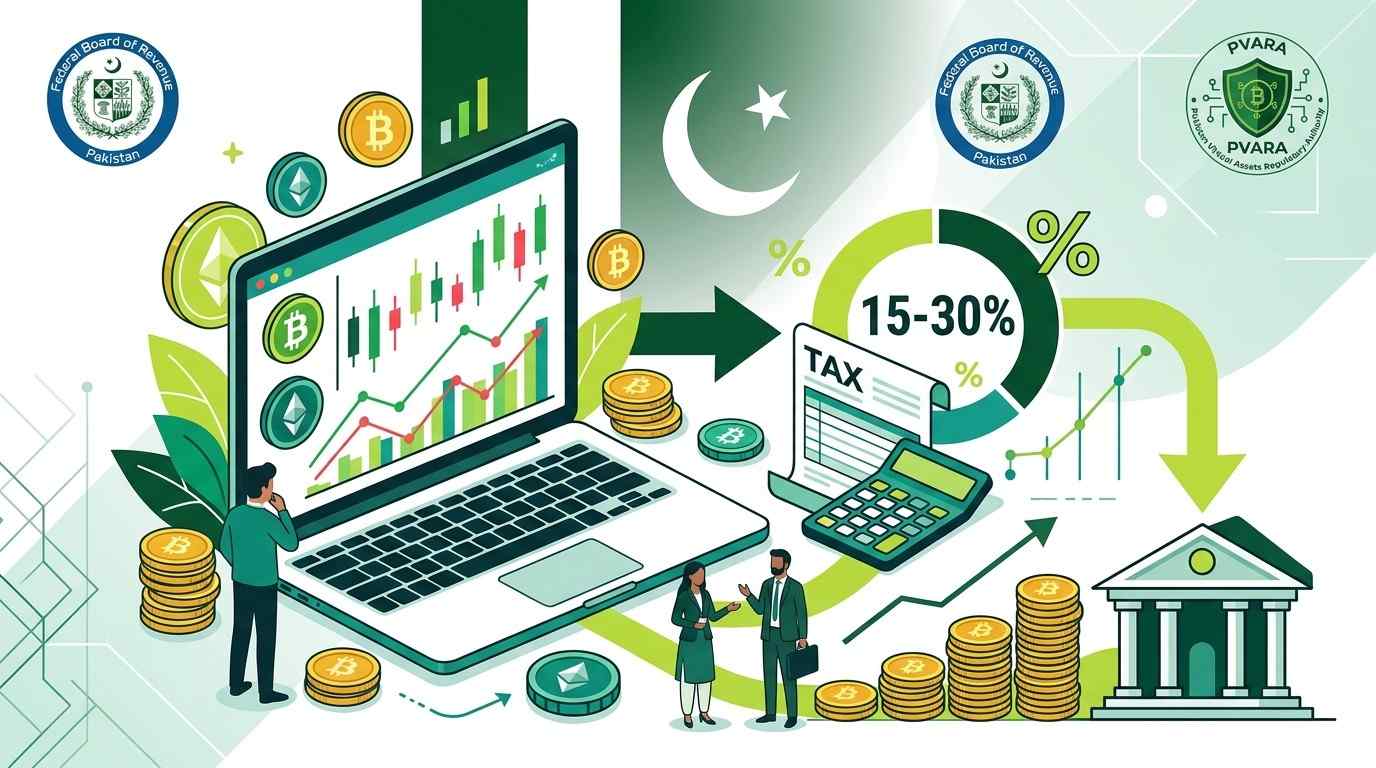
The federal government is now actively working to bring cryptocurrency into the formal tax system through the upcoming Budget 2026-27. If you trade Bitcoin, hold altcoins, or run a mining operation in Pakistan, this development directly affects your financial planning going forward.
Here is a clear, straight-to-the-point breakdown of what is happening, why it is happening, and what you need to do.
So What Exactly Is Being Proposed?
The government is considering a capital gains tax (CGT) on profits earned through cryptocurrency trading. This is not a tax on holding crypto — you won’t be taxed just for owning Bitcoin. The tax kicks in when you sell, trade, or commercially use your digital assets and make a profit.
Multiple credible sources published in early June 2026 confirm that the proposed rate falls somewhere between 15% and 30%. The exact figure hasn’t been locked in yet — that will happen when the Finance Bill 2026 is officially presented. But the direction is clear: crypto profits are entering the tax net, and the question is no longer if, but how much.
What Are Different Sources Reporting?
There’s some variation in the numbers depending on which sources you read, so here’s a consolidated picture based on verified reports:
- Daily Pakistan (June 2, 2026) — Reports a range of 15% to 30%, following direct IMF consultations urging Pakistan to document digital business income.
- Pakistan Times (June 3, 2026) — Confirms the 15–30% range and adds that the tax will likely be incorporated into Section 37 of the Income Tax Ordinance 2001 — the section governing capital gains in Pakistan.
- CoinEdition / CryptoNews (June 2, 2026) — Sources closer to the Finance Ministry point toward 20% to 30% as the more likely bracket.
- Skipper.pk (June 4, 2026) — Also reports the 20–30% range as the leading proposal.
- MEXC Learn / ICT.edu.pk — Note that a 15% flat CGT already exists under the 2025 Virtual Assets Ordinance for gains above PKR 500,000, and the new budget will either confirm, raise, or broaden this.
Bottom line: expect something in the 15% to 30% range when the Finance Bill drops.
The Legal Foundation: Virtual Assets Act 2026 and PVARA
This tax push doesn’t exist in isolation. It builds on a regulatory framework Pakistan put in place starting July 2025, when the Virtual Assets Act was passed and the Pakistan Virtual Assets Regulatory Authority (PVARA) was established.
Here is what that framework means in practical terms:
- Crypto is legal to hold and trade in Pakistan — but it is not legal tender. You cannot pay your electricity bill in Bitcoin.
- All exchanges, wallets, custodians, and investment platforms must hold a PVARA license to legally operate.
- Since April 2026, banks are allowed to open accounts for licensed virtual asset service providers.
- Starting July 2026, licensed exchanges must share user transaction data directly with the FBR under the Crypto-Asset Reporting Framework (CARF). This means your trades will be visible to the tax authority.
In short: the infrastructure for enforcement is already in place. The tax law is the last piece.
What Does This Mean for Bitcoin Miners?
Mining income is treated differently from trading gains, and this is important to understand.
Under the current framework, mining income is classified as business income under Section 18 of the Income Tax Ordinance 2001. This means it is taxed at progressive income tax slab rates — which can go up to 35% at higher income levels — rather than a flat capital gains rate.
The good news for miners is that operational costs are deductible. Electricity bills, hardware depreciation, facility expenses, and capital investment in mining equipment can all be offset against your taxable income. For registered mining businesses operating with proper NTN registration and PVARA compliance, this deduction structure makes a significant difference.
At Bitcoin Miner Pakistan, we have been running legal, documented mining operations since well before regulation arrived. We have always said that the only sustainable path in this industry is a compliant one — and that position has never been more relevant than it is today.
Why Is This Happening Now? The IMF Connection
Pakistan’s crypto tax push is directly tied to its ongoing engagement with the International Monetary Fund. The IMF has pushed Pakistan to expand its tax base and bring emerging digital economy sectors into the formal documentation system.
A Federal Tax Ombudsman (FTO) report also brought this issue into focus by highlighting that Pakistan has an estimated 9 million crypto users — the vast majority of whom have likely never reported digital asset gains in their annual tax returns. The FTO formally recommended that the FBR develop a clear policy on crypto holdings, income, and gains. That recommendation is now being turned into law.
What Happens If You Don’t Comply?
This is where people need to pay attention. The FBR is no longer operating on the assumption that crypto is invisible. Starting July 2026, licensed exchanges will feed transaction data directly to the tax authority. If your gains are on record and you haven’t reported them, the exposure is real.
The penalties under the current framework include:
- A 0.1% monthly fine on unpaid taxes for late filing
- A PKR 50,000 direct fine plus 100% of owed taxes for evasion
- Risk of account freezing and audits for undeclared holdings
To put this in perspective — in 2025, the FBR audited 5,000 cryptocurrency filers and recovered PKR 2 billion in unpaid taxes. Enforcement is already happening.
Key Takeaways for Pakistani Crypto Participants
- A capital gains tax of 15% to 30% on crypto trading profits is coming in Budget 2026-27. Final rate will be announced with the Finance Bill.
- The tax will be incorporated into Section 37 of the Income Tax Ordinance, making crypto profits formal taxable income.
- Mining income is taxed as business income — but operational deductions are available and can significantly reduce your liability.
- From July 2026, licensed exchanges must share your transaction data with FBR. Anonymity is no longer a realistic assumption.
- Crypto is fully legal in Pakistan — but it is now taxable, regulated, and increasingly documented.
- Registering your activity properly today protects you from penalties tomorrow.
Our Position at Bitcoin Miner Pakistan
We have been in this space since the early days — long before regulation, long before PVARA, long before any of this was a formal conversation in Islamabad. Our approach has never changed: run legal, documented, compliant operations.
The arrival of formal taxation is not a threat to serious participants. It is confirmation that Pakistan’s crypto economy is maturing. Businesses that registered early, kept proper accounts, and operated within the rules will benefit from this transition. Those who didn’t will face the consequences.
If you are running a mining farm, planning to start one, or need help navigating PVARA compliance and tax registration, we offer consultancy services covering the full process — from hardware import and farm setup to regulatory filing. Reach out to us here and let’s talk through your situation.
Sources
- Daily Pakistan — “Budget 2026-27: Pakistan may impose up to 30% tax on crypto gains” — June 2, 2026 — en.dailypakistan.com.pk
- Pakistan Times — “Pakistan Considers 15–30% Tax On Cryptocurrency Trading In Budget 2026-27” — June 3, 2026 — pakistantimes.com
- CoinEdition — “Pakistan Weighs Crypto Capital Gains Tax in Budget 2026-27” — June 2, 2026 — coinedition.com
- CryptoNews.net — “Pakistan Weighs Crypto Capital Gains Tax in Budget 2026-27” — June 2, 2026 — cryptonews.net
- Skipper.pk — “Crypto Trading Could Face 20–30% Tax” — June 4, 2026 — skipper.pk
- PhoneWorld — “Pakistan Cryptocurrency Tax Finance Bill 2026” — June 2, 2026 — phoneworld.com.pk
- MEXC Learn — “2026 Pakistan Crypto Tax Guide: Rates and FBR Filing” — mexc.com
- ICT.edu.pk — “Tax on Crypto Income Pakistan 2026: Complete FBR and PVARA Guide” — ict.edu.pk
Disclaimer: This article is for informational purposes only and does not constitute legal or financial advice. Tax laws are subject to change with the Finance Bill 2026. Please consult a qualified tax professional for advice specific to your situation.